Our Research
Directions
-
Development and implementation of long-term all-optical functional and structural monitoring of synaptic plasticity and stability
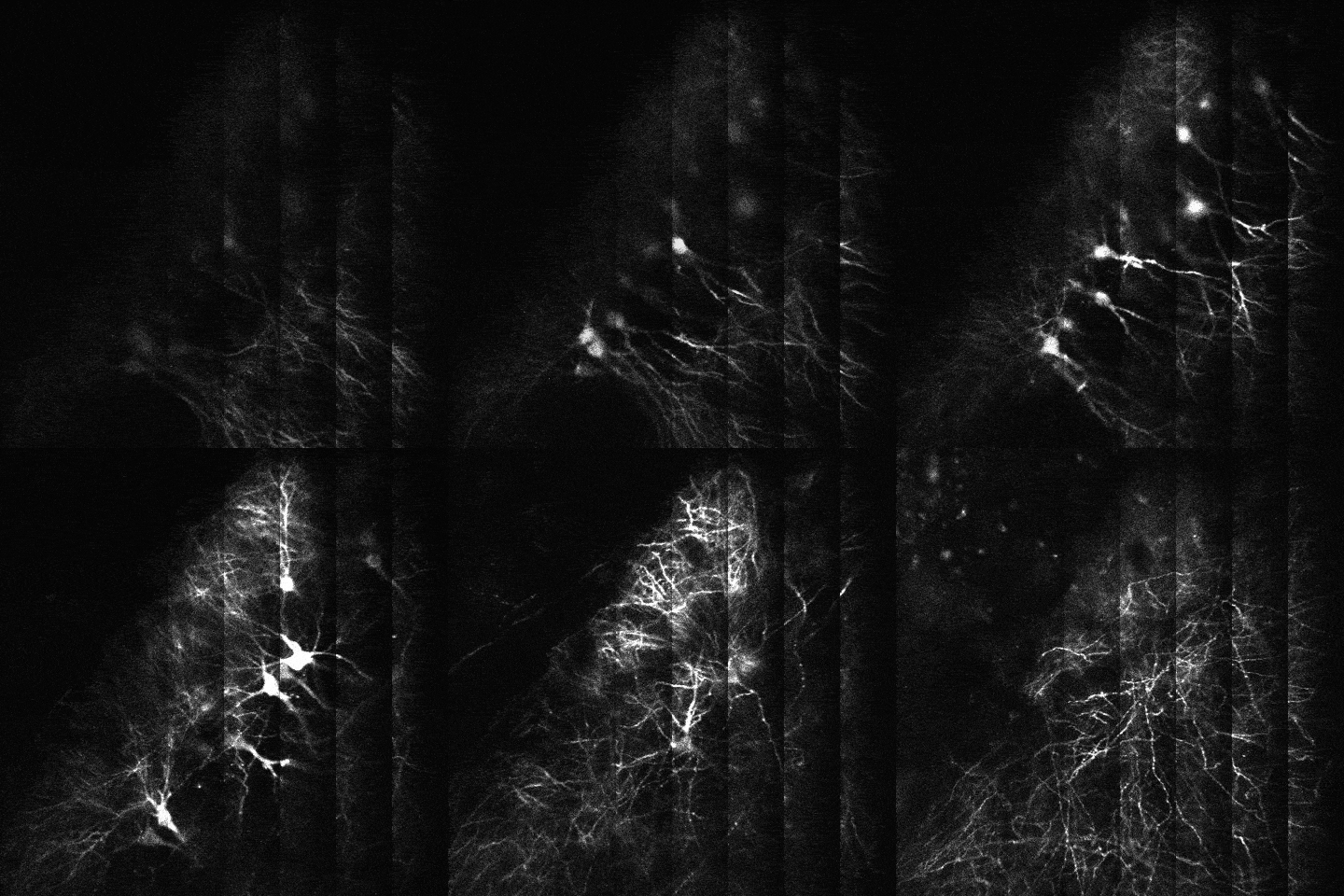
Use ultrafast 3D acousto-optical-deflector (AOD) two-photon imaging of genetically encoded voltage indicators and glutamate sensors to monitor synaptic memory strength and stability over days in dendritic spines of hippocampal pyramidal neurons during learning and retention, identifying stable vs. labile synapses. (Gonzalez et al., 2024, Nature)
Develop and implement all-optical phototagging methods to indelibly label synapses/neurons with identified memory strengths for post hoc molecular and ultrastructural analyses. (Shi et al., 2024, Nature Methods)
Establish chronic ex vivo assays in mouse and human cortical tissue to track synaptic protein dynamics with super-resolution imaging.
Apply these platforms to investigate how synaptic plasticity and stability are altered during aging and Alzheimer's disease (AD).
-
Identifying molecular and ultrastructural determinants of synaptic stability
Perform high-resolution post hoc imaging (expansion microscopy, super-resolution) to profile transcriptomic, proteomic, epigenetic, and ultrastructural features of synapses and cells identified in vivo as carrying stable weight changes.
Use unbiased proteomics with light-inducible proximity labeling at functionally identified synapses.
Carry out high-resolution ex vivo recordings in chronic human tissue to identify conserved structural, molecular, and genetic mechanisms of synaptic stability.
Integrate these approaches to define molecular/ultrastructural bases of impaired plasticity and stability in aging and AD.
Areas
Projects
At the Program in Memory Longevity (PML), our ongoing projects aim to unravel the fundamental neural mechanisms that support learning and memory—from the level of individual synapses to large-scale brain networks. By combining advanced in vivo imaging, electrophysiology, molecular profiling, and computational modeling, we investigate how memories are encoded, stabilized, and degraded across time. Our research bridges the gap between mouse and human systems to identify conserved cellular and circuit principles, while also uncovering how these mechanisms fail in aging and neurodegenerative disorders such as Alzheimer’s disease (AD). Through this integrated approach, we seek to translate basic discoveries into strategies for preserving and restoring memory function.
At the Program in Memory Longevity (PML), our ongoing projects aim to unravel the fundamental neural mechanisms that support learning and memory—from the level of individual synapses to large-scale brain networks. By combining advanced in vivo imaging, electrophysiology, molecular profiling, and computational modeling, we investigate how memories are encoded, stabilized, and degraded across time. Our research bridges the gap between mouse and human systems to identify conserved cellular and circuit principles, while also uncovering how these mechanisms fail in aging and neurodegenerative disorders such as Alzheimer’s disease (AD). Through this integrated approach, we seek to translate basic discoveries into strategies for preserving and restoring memory function.
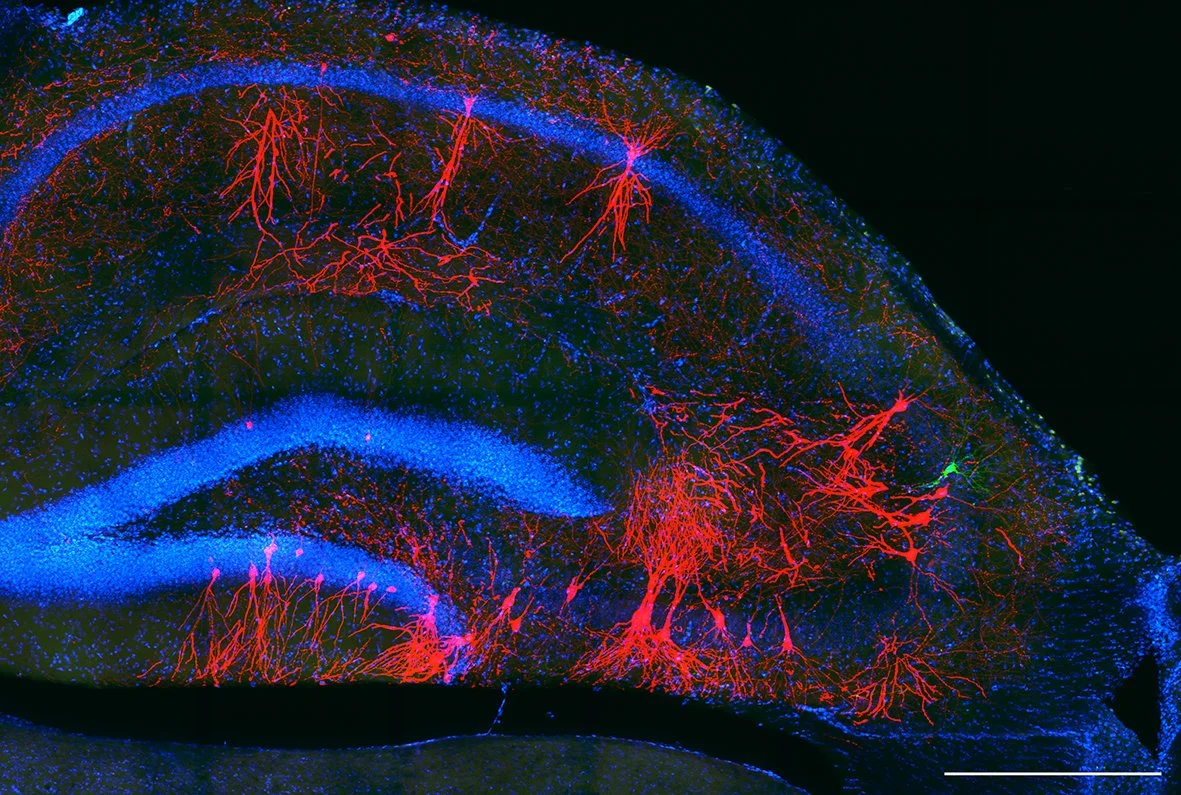
Ongoing projects in the lab are aimed at dissecting and understanding:
The hippocampal population code of spatial navigation and episodic learning in behaving animals
The role of developmental and functional heterogeneity of principal cells and microcircuits in hippocampal learning and memory formation
The role of hippocampal GABAergic circuits in spatial and episodic memory formation
Subcortical neuromodulation in hippocampal learning and memory formation
Connectivity maps of hippocampal microcircuits
Hippocampal microcircuit dysfunctions underlying cognitive memory deficits in genetic mouse models of neuropsychiatric disorders
Altered hippocampal circuit dynamics in temporal lobe epilepsy
Patch clamp electrophysiology of human brain tissue
Age-related remodeling of hippocampal circuits and synaptic plasticity underlying memory decline
Molecular and circuit mechanisms of impaired synaptic stability and network coordination in Alzheimer’s disease
Collaborations
-
Soltesz Lab
The Soltesz Lab's research focuses on inhibitory microcircuits to determine how distinct types of neurons communicate with each other in normal conditions and in epilepsy.
-
Nusser Lab
The main interest of the Nusser lab is understanding the operation of neuronal networks of the central nervous system, with a special focus on understanding the molecular, functional and structural diversity of nerve cells and their chemical synapses.
-
Zemelman Lab
The Zemelman lab strives to understand the role of hippocampus in memory formation by manipulating its functional elements, namely the assemblies of cells that carry out particular tasks. This objective raises four practical questions. How are such assemblies to be defined? How can they be accessed? How might their activity be perturbed? And how should the resulting change in the system be detected and evaluated?
-
Vaziri Lab
The central focus of the Vaziri lab is the development and application of new optical imaging technologies for large-scale, high-speed, and single-cell resolution interrogation of neuroactivity with the goal of advancing our systems-level understanding of brain function.
-
Poirazi Lab
The Poirazi lab is interested in understanding how dendrites and their integrative properties contribute to learning and memory functions.
-
Buzsáki Lab
Work in the Buzsáki lab focuses largely on the generation of these various oscillations, their spatial and temporal relationships, and the role of inhibition in the enforcement of syntactic rules.
-
Polleux Lab
The Polleux lab's work provides new insights into the cellular and molecular mechanisms underlying the establishment and maintenance of brain connectivity and has significant implications for our understanding of the pathophysiological mechanisms underlying socially-devastating neurodevelopmental disorders and neurodegenerative diseases.
-
Fusi Lab
Stefano Fusi wants to design technology inspired by the human brain. As a step toward this goal, he is using math to better understand how the brain itself computes information, especially as related to problem solving, reasoning and decision-making.
-
Gogos Lab
The Gogos lab has elucidated the contribution of rare de novo and inherited mutations to the genetic risk of schizophrenia and develops relevant model systems to understand their impact on neural mechanisms and advance neuropsychiatric therapeutics.
-
Paninski Lab
The Paninski lab develops statistical methodology for understanding how neurons encode information, how to infer the connectivity of large populations of neurons, and how to decode information from the brain.
-
Spiegel Lab
The Spiegelman Lab investigates how neural circuits adapt to experience and how these adaptations give rise to flexible behavior. Their research focuses on the molecular mechanisms—particularly signaling and transcriptional networks—that shape cortical neuron function and connectivity. Using genomic, molecular, biochemical, electrophysiological, and behavioral approaches, they examine how experience-induced molecular programs in defined cortical cell types regulate cortical processing. Their work aims to uncover how nature and nurture interact to drive adaptive behavior and to understand how genetic variation in these pathways contributes to individual differences in cognition and susceptibility to psychiatric disorders.
-
Peterka Lab
Darcy Peterka strives to develop and deploy cutting-edge optical and algorithmic methods to record and manipulate the activity of brain cells, or neurons. Working together with researchers across the Zuckerman Institute at Columbia University and beyond, he also brings together and collaborates with interdisciplinary teams that combine advances in physics, chemistry, mathematics and statistics to bear on complex and challenging questions about the brain and its functions.